Fiocruz, INCA and Étikos discuss ethics in research at Latin American event
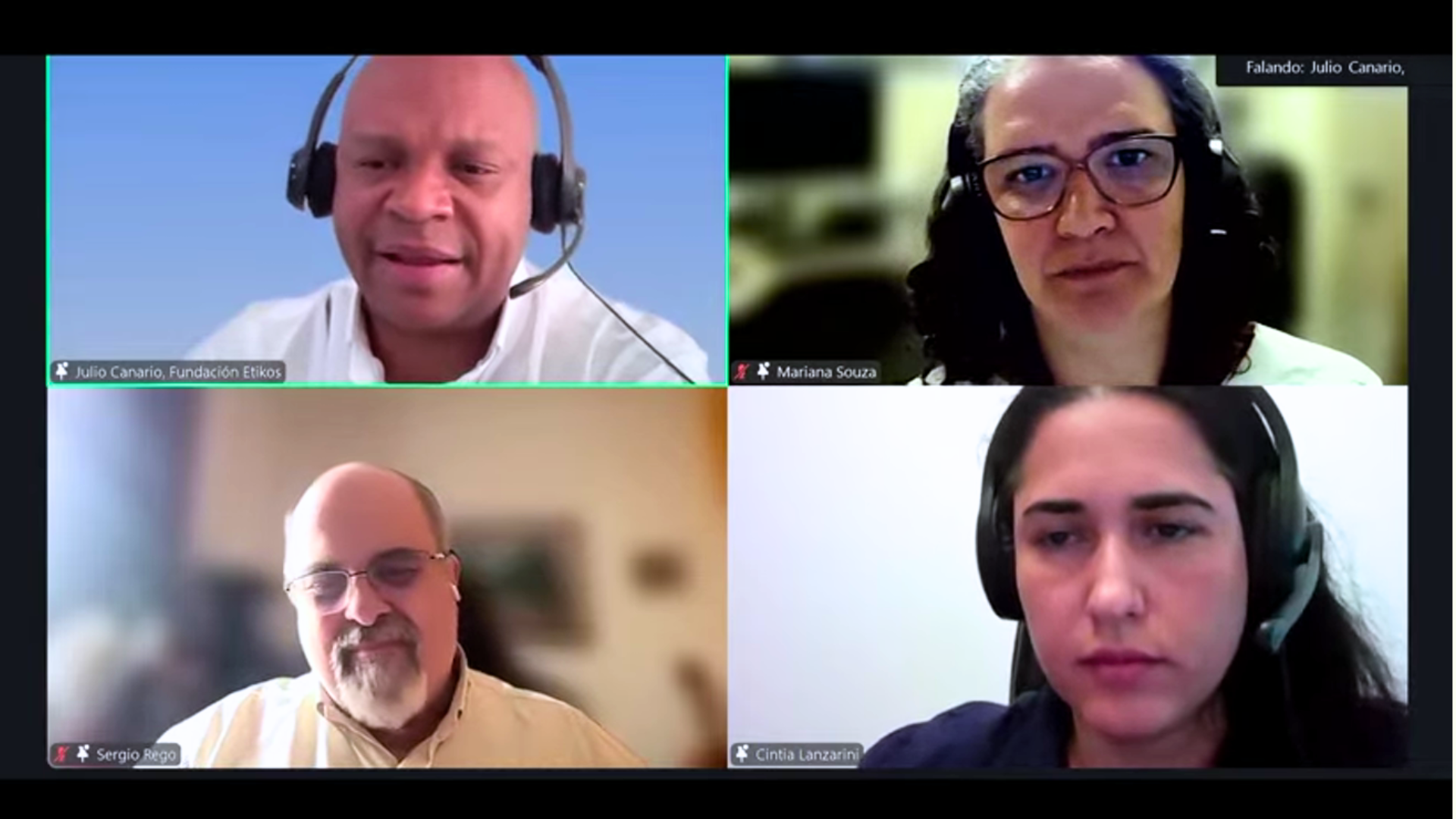
With more than 400 participants from 30 countries, the webinar “Educational Opportunities in Ethics and Research Integrity”, held on the 26th, brought together researchers from Fiocruz and the National Cancer Institute (INCA) to discuss training initiatives and challenges of scientific integrity in the Latin American context. The session was broadcast in Portuguese and Spanish on YouTube, and it was moderated by the researcher at the Étikos Foundation (Dominican Republic) and member of the consortium The Global Health Network Latin America and Caribbean (TGHN LAC), Julio Canario.
Scientific integrity has gained increasing relevance in the global academic debate in light of the rise in article retractions, misuse of data, and the impact of artificial intelligence on knowledge production. In Brazil, the absence of a unified national regulation makes institutional training even more strategic, a path already taken by Fiocruz, with milestones such as the creation of the Integrity Commission in 2012, the publication of the Research Integrity Guide in 2019, and its renewal in 2023.
Fiocruz Open Course on Ethics and Research Integrity
Fiocruz researcher, Mariana de Souza, presented the Open Course on Ethics and Research Integrity, available in Portuguese, and free of charge on the Virtual Campus. Divided into five modules, the training covers topics ranging from the fundamentals of ethics to issues such as plagiarism, falsification, animal experimentation, and the ethical use of generative artificial intelligence.
“We created transversal subjects, designed to have a common foundation: whether a student of History or of Cell Biology, we provide the same basis. The content is free, can be accessed by anyone on the Virtual Campus, and has already reached more than 4,000 registrations worldwide,” she said.
As the next step, Mariana announced a partnership with TGHN LAC for the translation of the material into Spanish and its adaptation to the Latin American context. The Spanish version is already underway.
PPGBIOS: Bioethics, Applied Ethics and Public Health
Fiocruz researcher and one of the coordinators of the Postgraduate Programme in Bioethics, Applied Ethics and Public Health (PPGBIOS) at Fiocruz, Sergio Rego, presented the initiative that brings together four institutions in Rio de Janeiro: Fiocruz, UFRJ, UFF and UERJ in a single programme.
In addition to the relevance of interinstitutional coordination, Rego highlighted the importance of a paradigm shift in the subject, from the Global North to the Global South, as well as the practical application of ethics. “Bioethics cannot be an abstract application of universal principles, a top-down approach. In our programme, ethical reflection begins with factual reality: the lack of water in the favela, the transplant waiting list, and the patterns of scarcity surrounding human existence,” he argued.
Research highlights researchers’ perception of scientific integrity
Next, INCA technologist Cíntia Lanzarini presented the results of her doctoral research on Fiocruz researchers’ perception of scientific integrity. The study gathered 310 participants, mostly PhDs with more than ten years of experience. Half declared familiarity with the subject; the other half reported partial or no knowledge. Around 75% knew definitions of misconduct such as fabrication, falsification and plagiarism, but approximately 10% did not recognise them as harmful practices.
“We found that only three of the 69 pharmacy programmes in Brazil offer compulsory subjects exclusively dedicated to either ethics or integrity. There is an urgent need for greater incorporation of teaching on this subject in researcher training at all levels,” she concluded.
Audience questions reveal field tensions
The debate with the audience raised questions about the impacts of recent regulatory changes in Brazil, which remove the National Research Ethics Commission from the social control of the National Health Council, about distance learning modalities, and about how to respond to institutional pressures for productivity. Sergio Rego commented: “There should be no flexibility when it comes to scientific integrity,” warning that errors in research can have serious consequences for public health and that managers and researchers share responsibility for the studies conducted in their institutions.
Next event in the series
This webinar was organised by the Ethics and Integrity Working Group within TGHN LAC, led by the Étikos Foundation with the participation of Fiocruz and other consortium members. The event is part of a monthly series of webinars by TGHN LAC. The next webinar in the series is scheduled for 26 March, at 2 p.m. (Brasília time), with the theme “Research Ethics Committee: promoting responsible conduct to strengthen the research ecosystem of the Teaching Hospital” (from Spanish, “Comité de Ética en Investigación: fomento de la conducta responsable para fortalecer el ecosistema de investigación del Hospital Escuela, Tegucigalpa, Honduras”) and will be held exclusively in Spanish.
Written by Luisa Picanço (TGHN LAC/ Fiocruz).